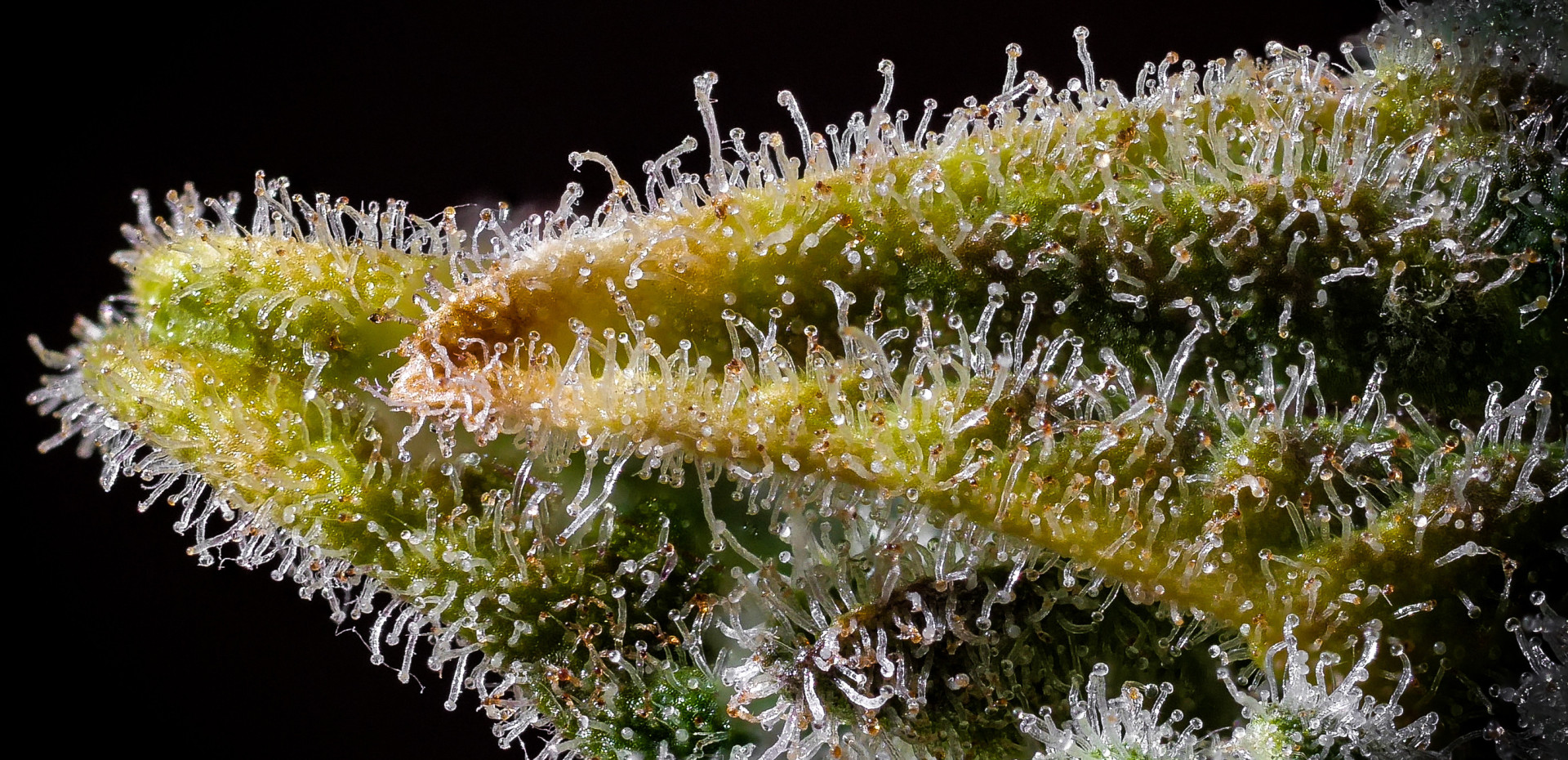
1. Three families—not to be confused
The term refers to three very different things, and confusion is deliberately perpetuated by some players in the market.
- Phytocannabinoids —produced by the plant. CBD, THC, CBG, CBN, CBC, and about a hundred others.
- Endocannabinoids —produced by your own body, regardless of any consumption.
- Synthetic cannabinoids —created in a lab, with no connection to the plant other than a brand name.
It’s the third category that’s sending people to the hospital. These molecules have neither the behavior nor the safety margin of phytocannabinoids, and their composition changes every few months to stay one step ahead of the law. We’ve dedicated an entire article to this topic: what’s being sold as CBD in 2026.
2. Acid forms, and why they matter to you
This is the least well-known yet most useful concept.
The living plant produces neither CBD nor THC. It produces their acidic forms—CBDA and THCA—which have an extra carboxyl group.
This group disappears when exposed to heat or over time. This is called decarboxylation, and it’s what happens when a product is heated, steeped, or simply allowed to age.
A direct and very practical consequence: a lab report must indicate “total THC,” which is the sum of the THC that has already formed and the converted THCA. This is the figure that matters during an inspection, not THC alone. A product that complies with one standard may be illegal under another.
3. The molecules you’ll encounter
| Molecule |
What it is |
Status |
| CBD |
The primary cannabinoid in hemp; non-psychoactive |
Legal under certain conditions |
| THC |
The psychoactive compound, subject to a legal threshold |
Restricted by law |
| CBG |
The molecule from which others are derived during growth |
Legal |
| CBN |
A breakdown product of THC over time |
Variable |
| CBC |
Minor cannabinoid, little studied |
Legal |
CBG deserves special mention: it is the common precursor, and a plant that remains rich in it contains very little THC. This property has made it both a regulatory tool and a product, which we detail in our article on the specific case of CBG.
As for the CBD vs. THC distinction, which shapes the entire legal market, it is the subject of a dedicated article: THC and CBD Compared.
4. Full-spectrum, broad-spectrum, isolate
Three terms that describe what remains after processing.
- Full spectrum — everything the plant has produced is retained, including minor cannabinoids and terpenes.
- Broad spectrum — THC has been removed, while the rest is retained. The process is never entirely neutral.
- Isolate — a single molecule, purified to 99%. Nothing else.
An isolate has no smell, taste, or color. That’s why products containing it must have terpenes added to make them resemble something—a useful benchmark when evaluating a resin.
5. What We Know, and What We Don’t Know
We need to be straightforward about this, because this is where the market goes off the rails.
What’s established: these molecules interact with a receptor system in the body. THC is psychoactive; CBD is not.
What isn’t established: virtually all of the effects attributed to minor cannabinoids. CBG, CBN, and CBC have been little studied in humans, and the claims circulating about them are most often based on in vitro studies or on doses unrelated to actual use.
We sell resin and flowers. We do not sell medicine —and we do not claim to know what research has not yet established. Details of what has been documented can be found in our article on what the research actually shows.