1. What exactly is a micron?
A micron, or micrometer, is one-thousandth of a millimeter. Here are three points of comparison:
- a human hair is about 70 microns in diameter;
- a grain of fine sand is about 200 microns;
- the naked eye can no longer distinguish an individual detail at around 50 microns.
When sifting at 90 microns, we’re working on a scale where the eye can no longer keep up. That’s what makes marketing claims so easy here: no one can verify them by sight.
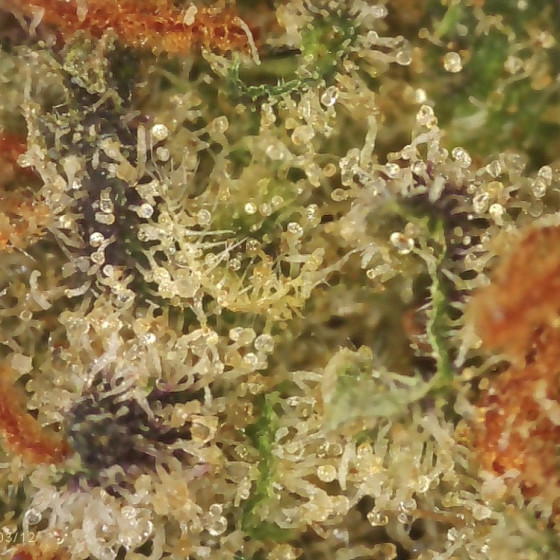
What interests us at this scale are the trichome heads. Their diameter isn’t fixed: it varies depending on the strain, maturity, and growing conditions.
2. The number refers to the hole, not what remains on the screen
The number on a sieve indicates the size of its openings.
- A 120-micron sieve has mesh openings measuring 120 microns on each side.
- Anything smaller than 120 passes through: small glands, dust, and fragments.
- Anything larger than 120 stays on top: leaves, flower parts, stems.
What collects beneath a 120-micron sieve is therefore not “120.” It is everything smaller than 120 —including plant dust.
3. Why a fraction is always written with two numbers
A properly described resin isn’t represented by one number, but by two. It has passed through one sieve and been retained by a finer one.
A 90-120 fraction passed through the 120-mesh screen and was retained by the 90-mesh screen: the larger pieces were removed at the top, and the dust at the bottom. What remains in the middle are the buds of the correct size.
When dealing with a seller: if only a single number is given, either they’re oversimplifying, or they’ve never sieved anything at all.
4. The Three Factors the Number Doesn’t Capture
Temperature
Cold makes the gland brittle and facilitates its separation. Too cold, and it breaks; too hot, and it sticks and gets crushed against the mesh.
The moisture content of the raw material
This is the most underestimated factor. If it’s too moist, it won’t pass through anything. If it’s too dry, it crumbles into dust and contaminates all the fractions.
Agitation time
The first few minutes release the ripest glands— this is the prime portion. The longer you continue, the more plant material you extract. Knowing when to stop is better than knowing how to keep going.
These settings are detailed in our guide to sifting at home.
5. What Each Fraction Actually Contains
The principle applies to both dry sifting and bubble hash— only the agitation method changes. See the five extraction methods.
| Fraction |
What’s in it |
Appearance |
| Above 153 µ |
Plant material, a few very large buds |
Green, powdery |
| 120–153 µ |
The largest buds, some debris |
Dull blond, sandy |
| 90–120 µ |
The main part of the harvest for many strains |
Golden blond, shiny |
| 70–90 µ |
Smaller buds, very clean sorting |
Light blonde, fine base |
| Under 70 µ |
Small buds, young glands, trichome stalks |
Light-colored, dense powder |
Finer doesn’t necessarily mean better. Very fine sifting yields a visually flawless product that may disappoint on the palate. A broken bud has lost some of its terpenes before reaching the tray.
Coarser doesn’t mean bad. A 120–153 fraction from a plant with large glands outperforms a fine fraction derived from mediocre material. The quality of the source material always takes precedence over the fineness of the sorting.
6. Anything under 70 microns isn’t waste
We read everywhere that anything that falls below the commercial fraction is considered waste. That’s not true. There are three very real things in there:
- small glands, finer than the batch average;
- young trichomes, which had not yet completed their development;
- trichome stalks —the stem that supported the head, which is not inert.
The concentration is lower here, and the profile is different—more plant-like. That’s not the same as being worthless. To understand why these fragments matter, you have to look at how the plant builds these glands: not everything matures at the same rate on a single plant.
Here, nothing goes in the trash.
On an industrial scale
These fractions are extracted using solvents in a laboratory with appropriate venting equipment. This is not something to attempt at home: the solvents used are volatile and flammable.
At home
The traditional method is infusion in a fat-based medium, such as Marrakech butter, and the CBD version follows the same principle. Cannabinoids and terpenes are fat-soluble: material that’s too low in content to be pressed can still be put to use once infused.
7. What the Number Will Never Tell You
A micron is a mechanical measurement. It says nothing about:
- the quality of the raw material —a fine sieve won’t catch a moldy flower;
- freshness —poorly stored resin loses its aroma regardless of its fraction;
- the presence of additives — no one verifies this number;
- the pressing process —if it’s too hot, it degrades in minutes what the sifting took hours to isolate.
It sounds technical, it’s reassuring, and it doesn’t commit you to anything. Other signs of a questionable product are covered in our article on fake resins.